Mammoth Dumpster Rental runs contractor and commercial accounts for crews that need bins on more than one job, renovation firms working Elmwood Village doubles, roofers tearing off in North Park, and estate cleanout…
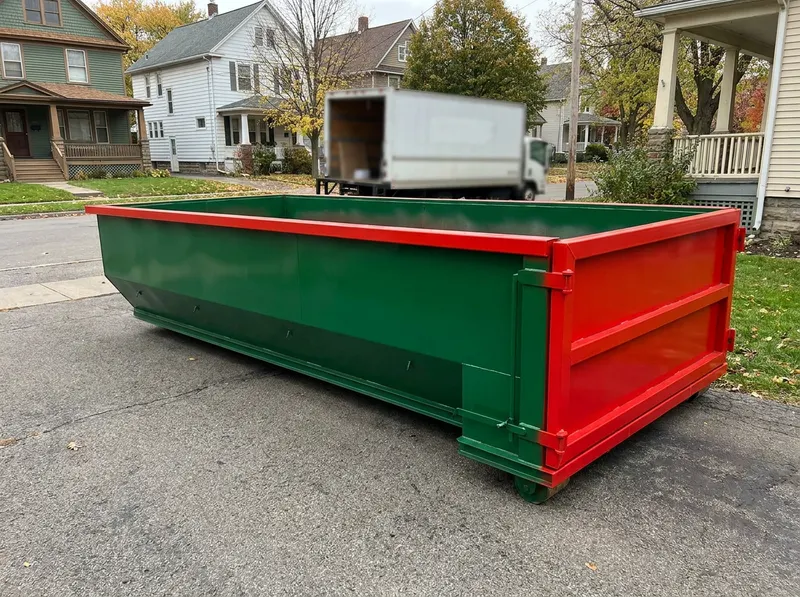
Mammoth Dumpster Rental runs contractor and commercial accounts for crews that need bins on more than one job, renovation firms working Elmwood Village doubles, roofers tearing off in North Park, and estate cleanout teams clearing homes near Forest Lawn Cemetery. The account model holds one flat price per size across every drop, so a project manager billing several Allentown jobs sees the same $695 for a 20-yard whether it is the first bin or the tenth. That flat structure matters on C&D work because debris weight is unpredictable: a 20-yard packed with plaster and lath can weigh far more than one filled with cabinetry, and construction and demolition materials make up a large share of U.S.
landfill volume. The account price stays flat regardless.
Size the bin to the job, not the other way around. A 10-yard ($595) holds roughly four pickup-truck loads and fits a single-bathroom gut or a small deck tear-down; a 15-yard ($650) suits a kitchen remodel or one-floor flooring pull; a 20-yard ($695) handles a mid-size renovation or a two-layer roof tear-off on a Kenfield cape; a 30-yard ($795) fits full-house cleanouts and framing debris; a 40-yard ($895) absorbs large commercial demo and new-construction scrap.
The trade-off is driveway footprint against haul frequency, a 30-yard means fewer pickups but needs a longer clear stretch, while two 10-yards keep tight Riverside and University Heights lots workable. Heavy inert loads like concrete, brick, and asphalt shingle carry weight caps on the larger sizes, so dense material usually runs best in a 10- or 15-yard; our team confirms the right pairing before the drop.
A dumpster rental is not junk removal, the crew loads the bin, Mammoth delivers and hauls it. Bins sit level-loaded (fill to the top rail, nothing mounded over) so the truck can tarp and transport legally.
Prohibited items are consistent across every account: no wet paint, solvents, fuels, asbestos, or other household hazardous waste, no tires, no appliances with refrigerant, and no liquids. Our team handles e-waste and electronics separately under state electronic waste rules, so monitors and devices from an office clearout stay out of the bin. Keeping prohibited items out protects the flat price and keeps loads compliant with OSHA construction and 1926.252 waste disposal expectations for a clean, hazard-free job site.
Placement follows a short sequence.
Step 1: call (716) 347-3573 or text a job-site photo and the crew matches a size. Step 2: pick a drop spot, driveway, private lot, or street. Step 3: if the bin sits on a Buffalo street or blocks a lane, the job site needs a right-of-way permit from the City of Buffalo permits office, and contractors should confirm whether the Erie County job address falls inside city limits before scheduling.
Step 4: Mammoth delivers and the crew loads. Step 5: call for pickup when the bin is full or the window closes. Standing weekly or biweekly swaps work well for longer builds near Canalside and Larkin Square, where a fixed bin stays put and gets emptied on a set day.
Recovery and recycling rates for mixed C&D debris are tracked nationally through construction and demolition recycling reporting and sustainable-material guidance from public sustainability programs, and separating clean wood or metal on larger jobs can reduce landfill tonnage.
Every job gets a firm, written price after an on-site visit.
Tell us about your contractor & commercial accounts job in Buffalo and we'll send a clear, written quote, usually the same day.
 Mammoth Dumpster Rental